
What Is Answer Engine Optimisation? A Guide to the Future of Search Marketing
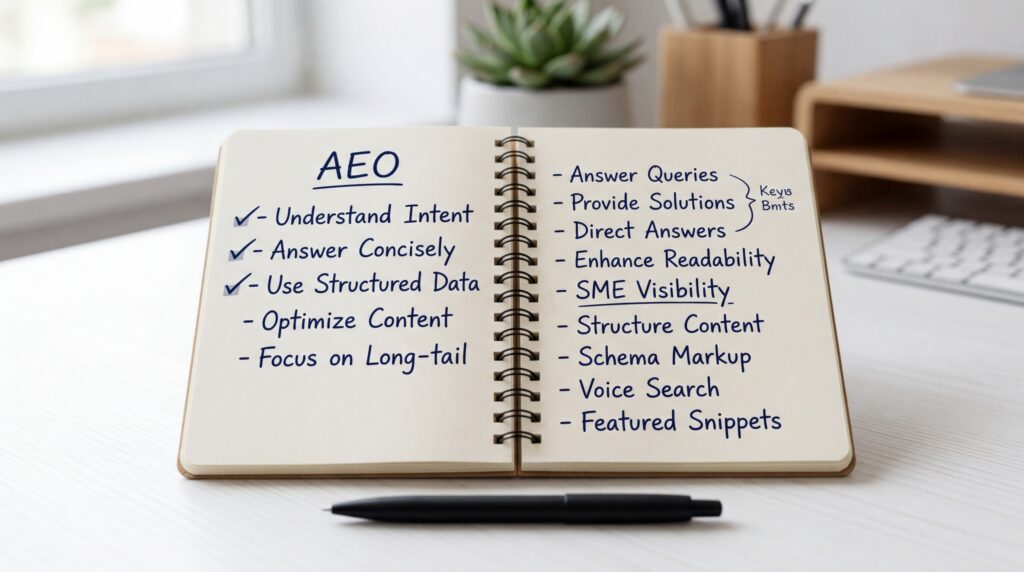
Search engines are changing. Instead of showing you a list of links, AI tools like ChatGPT, Perplexity, and Google’s AI Overviews now give direct answers to questions. This shift means your content needs to work differently to get noticed.

Answer Engine Optimisation (AEO) is the practice of structuring your content so AI systems select your brand as a cited source when generating answers. Rather than focusing only on search rankings, you now need to optimise for being included in AI-generated responses. This matters because more people are getting information directly from AI tools without clicking through to websites.
The good news is that AEO builds on what you already know about SEO. You’ll use many familiar tactics like creating quality content and building authority. But you’ll also need to learn new approaches for how AI systems find, understand, and cite information. This guide will show you exactly how to adapt your strategy for the age of answer engines.
What Is Answer Engine Optimisation?

Answer Engine Optimisation (AEO) is the practice of structuring your content so AI-powered systems choose your brand as a trusted source when generating answers to user questions. Instead of focusing on rankings in traditional search engines, AEO targets platforms like ChatGPT, Perplexity AI, Google AI Overviews, Copilot, Claude, and Gemini that deliver direct responses rather than lists of links.
The Shift from Search Engines to Answer Engines
Traditional search engines display a list of web pages for you to browse through. Answer engines work differently by synthesising information from multiple sources and presenting a single, direct answer to your query.
This shift changes how you need to approach content optimisation. Where SEO focused on improving your position in search results, AEO focuses on making your content easy for AI systems to understand, trust, and cite.
AI-powered search tools like Google AI Overviews and Perplexity don’t just index your content. They read it, interpret it, and decide whether it’s reliable enough to include in their generated responses. Your goal is to structure information clearly so these systems recognise your content as authoritative.
Voice assistants like Alexa and Siri also rely on answer engine principles. When users ask questions verbally, these systems pull from sources optimised for direct, conversational answers rather than traditional keyword-focused content.
Direct Answers and Zero-Click Searches
Zero-click searches occur when users get their answer directly on the results page without clicking through to any website. AI Overviews and featured snippets are common examples where your content provides value but may not drive direct traffic.
AEO embraces this reality by focusing on visibility and brand authority rather than click-through rates alone. When ChatGPT or Perplexity cites your brand in an answer, you build recognition even without a website visit.
These AI-powered answer engines use large language models (LLMs) to generate responses based on their training data and retrieved information. Your content needs to be structured with clear answers, proper schema markup, and reliable information that these systems can confidently reference.
The trade-off is different from traditional SEO. You may receive fewer clicks, but you gain exposure as a trusted source across multiple AI platforms simultaneously.
Key Platforms Driving AEO
Conversational AI platforms like ChatGPT, Claude, and Gemini generate detailed answers to user questions. These systems cite sources they trust, making your brand visible to users seeking expert information.
AI-enhanced search engines include Google AI Overviews, Perplexity AI, and Copilot. These platforms combine traditional search with AI-generated summaries that appear at the top of results pages.
Voice search assistants rely on answer engine principles to provide spoken responses. When you optimise for AEO, you simultaneously improve your chances of being featured in voice search results.
Each platform has different requirements, but they all prioritise content that’s well-structured, factually accurate, and easy to understand. Your optimisation efforts should address these common factors whilst considering the unique characteristics of each answer engine.
AEO vs. Traditional SEO: The Core Differences

Traditional SEO aims to rank pages higher in search results, whilst AEO focuses on getting your content selected as direct answers in AI responses and featured snippets. The metrics you track, the user intent you target, and the platforms you optimise for all change between these two approaches.
Goals and Metrics
Traditional SEO measures success through organic traffic, click-through rate, and search visibility in search engines like Google. You track rankings for specific keywords and monitor performance through Google Search Console. The goal is to drive visitors to your website where they can explore multiple pages and take desired actions.
AEO prioritises being the chosen source for direct answers. Your content needs to appear in featured snippets, AI-generated responses, and voice assistant results. Success means your information gets delivered directly to users without them necessarily clicking through to your site. You measure how often your content is cited as an answer rather than counting page visits.
Both approaches still require a strong SEO foundation. Your site needs proper crawlability, authority signals, and technical optimisation. However, AEO shifts the focus from traffic volume to answer quality and source credibility, including E-E-A-T signals that help AI systems trust your content.
User Intent and Query Types
Traditional SEO targets a broad range of user intent, from informational searches to commercial queries. You optimise for short keywords and long-tail phrases that people type into search boxes. Search behaviour typically involves users comparing multiple results and clicking through several links.
AEO specifically targets question-based queries and conversational search patterns. Users ask complete questions through voice assistants or expect immediate answers in AI chat interfaces. Your content must provide clear, concise responses that answer specific questions directly. The format matters more than keyword density.
The knowledge graph plays a larger role in AEO because AI systems pull structured data to form answers. You need to present information in ways that these systems can easily extract and synthesise into direct responses.
Platforms and Search Environments
Search engine optimisation traditionally focuses on Google, Bing, and other conventional search engines where users browse ranked lists of links. You optimise title tags, meta descriptions, and on-page elements to attract clicks from search results pages.
AEO extends across AI chatbots, voice assistants, and platforms that generate answers rather than link lists. This includes ChatGPT, voice search on mobile devices, and AI overview features in search engines. Your content must work across these varied environments where the presentation format differs completely from standard search results.
You cannot ignore traditional search visibility whilst pursuing AEO. Most users still rely on conventional search engines for many queries. The platforms overlap, and many of the optimisation techniques support both approaches when applied correctly.
How Do Answer Engines Source and Cite Content?

Answer engines use large language models to find and select information from across the web, then cite sources based on trust, relevance and data structure. Your content needs proper formatting and consistent brand mentions to earn AI citations.
Role of Large Language Models and AI
Large language models power answer engines by processing queries through natural language processing. These AI systems don’t search the web in real-time like traditional search engines. Instead, they use a method called RAG (Retrieval Augmented Generation) to find relevant information.
RAG works in two stages. First, the system searches for content that matches the query using vector search, which looks for semantic similarity rather than exact keyword matches. Second, it generates an answer by synthesising information from multiple sources.
The AI evaluates content based on how well it answers the specific question. It looks at factors like topical relevance, content depth and how clearly information is presented. Natural language processing helps the system understand context and extract the most useful facts from your pages.
Importance of Citations and Brand Mentions
AI citation happens when an answer engine references your brand as a source in its response. Answer engines prioritise content that appears across multiple credible sources because this corroboration signals authority.
Brand mentions across different platforms strengthen your chances of being cited. When your website, reviews, community discussions and third-party publications all confirm the same information about your brand, AI models view this consensus as reliable.
Trust matters more than any single factor. Answer engines cross-reference information to verify accuracy before including it in responses. Your content needs backing from authoritative sources to earn citations consistently.
Structured Data and Schema Markup
Structured data uses Schema.org vocabulary to label content in a way that AI systems can easily interpret. Schema markup tells answer engines exactly what information means, making it simpler for them to extract and attribute facts correctly.
FAQ schema marks up question-and-answer pairs on your pages. Article schema identifies key elements like headlines, authors and publication dates. Both formats help large language models understand your content structure quickly.
Structured content goes beyond technical markup. Use bullet points, clear headings and concise paragraphs to make information scannable. Answer engines prefer content that’s already organised logically because it’s easier to process and cite accurately.
Core AEO Strategies for Maximum Visibility
To rank in AI-generated answers, you need to structure your content around natural questions, establish genuine expertise, and build trust signals that AI systems recognise as credible.
Focusing on Conversational Questions
AI tools generate answers based on how people naturally ask questions. You need to identify the exact questions your audience asks and structure your content around them.
Use question-based headings throughout your content. These should match real queries people type into search bars or voice assistants. Instead of “Product Features”, write “What features does this product include?”
Research conversational search patterns in your industry. Look at “People Also Ask” boxes, review customer support tickets, and monitor social media discussions. These sources reveal the natural language your audience uses.
Answer each question directly within the first few sentences beneath the heading. AI systems prioritise content that provides immediate, clear answers without requiring users to read several paragraphs first.
Structure your content format to support scanning. Use short paragraphs of 1-3 sentences. This content structure helps AI systems extract specific information more easily.
Creating High-Quality and Authoritative Content
AI engines cite sources that demonstrate expertise and reliability. Your content strategy must prioritise depth and accuracy over word count.
Include specific data, research findings, and expert insights. AI systems favour authoritative content that references verifiable information rather than vague claims or generic advice.
Add author bios that showcase relevant credentials and experience. These authority signals tell AI tools that real experts created your content. Include professional qualifications, years of experience, and links to other published work.
Update your content regularly to maintain accuracy. AI systems check publication dates and favour current information for time-sensitive topics.
Format your content for clarity using lists, tables, and bold text for key points. High-quality content presents information in ways that both AI systems and humans can easily process.
Create comprehensive answers that address follow-up questions within the same piece. This approach increases the likelihood that AI tools will cite your content as a complete source.
Building Authority with Backlinks and Mentions
Backlinks from trusted websites signal to AI systems that your content deserves citation. You need to earn these links through genuine value rather than manipulation.
Focus on getting authoritative backlinks from established publications, industry associations, and educational institutions. AI engines weigh these links more heavily than links from unknown sources.
Build your brand presence across platforms where your audience gathers. When multiple sources mention your brand or content, AI systems interpret this as proof of credibility.
Guest post on reputable sites within your field. These opportunities create backlinks whilst expanding your brand visibility to new audiences.
Earn media coverage and citations from journalists and researchers. These mentions generate referral traffic and strengthen your authority signals in ways that AI systems recognise.
Monitor your existing backlinks and maintain relationships with sites that link to you. A steady pattern of quality links indicates ongoing relevance rather than temporary popularity.
Technical and On-Page Optimisation for AEO
Getting your content selected by AI systems requires proper technical setup and clear on-page structure. Schema markup helps AI understand your content, clean formatting makes it easier to extract answers, and voice-optimised content increases your chances of being featured across different platforms.
Implementing Schema and Structured Markup
Schema markup tells AI systems exactly what your content means. You need to add structured data from Schema.org to your pages so answer engines can quickly identify key information.
Start with Article schema for blog posts and news content. This markup includes fields for headline, author, date published, and main content. FAQ schema works well for Q&A style content, whilst HowTo schema suits step-by-step guides.
Product schema is essential for e-commerce sites. It provides price, availability, and review data that AI systems pull into their answers. Local businesses should implement LocalBusiness schema alongside their Google Business Profile to appear in location-based queries.
The key is accuracy. Your structured data must match the visible content on your page. Use Google’s Rich Results Test to check your markup works properly. Many content management systems offer plugins that add basic schema automatically, but you’ll often need to customise it for best results.
Enhancing Readability and Accessibility
AI systems favour content that’s easy to parse and understand. Write short paragraphs of 1-3 sentences. Use clear headings that describe what each section covers.
Break up complex information with bullet points and numbered lists. These formats help AI extract specific facts quickly. Keep sentences under 20 words when possible.
Your technical SEO matters too. Fast page loading speeds and mobile-friendly design affect whether AI systems consider your content reliable. Check your site’s crawlability using Google Search Console to ensure AI bots can access your pages.
Use descriptive alt text for images and proper heading hierarchy (H1, H2, H3). These elements help AI understand your content structure. Avoid walls of text—white space makes content easier to process for both humans and machines.
Optimising for Voice and AI Assistants
Voice searches through Siri, Google Assistant, and other voice assistants require different optimisation. People speak queries differently than they type them, using more natural, conversational language.
Target question phrases that match how people actually talk. “What’s the best way to…” or “How do I…” are common voice search patterns. Your content should provide direct answers in the first sentence or two.
Featured snippet boxes often become voice search answers. Structure your content to answer specific questions within 40-50 words. Voice assistants typically read these condensed answers aloud.
Local optimisation matters for voice search. Complete your Google Business Profile fully and keep information consistent across all platforms. Voice assistants pull from local business data when answering “near me” queries.
Format answers as complete sentences rather than fragments. Voice assistants need content they can read naturally without additional context.
Measuring Success and Tracking AEO Performance
Tracking AEO performance requires monitoring where your brand appears in AI-generated answers and measuring how often AI tools cite your content. You’ll need to combine traditional analytics with new AI-specific metrics to get a complete picture of your visibility.
Tracking Citations and Mentions
The most important metric for AEO is tracking how often AI engines cite your content as a source. You need to monitor mentions across multiple platforms, including ChatGPT, Perplexity, Google’s AI Mode, and Microsoft Copilot.
Start by manually searching for your brand and key topics in different AI tools. Record when your content appears as a citation or reference. Create a spreadsheet to track the date, AI platform, query used, and whether you received a direct citation or just a mention.
For Google specifically, citations from AI Overviews appear in Search Console under the “Web” search type in your Performance report. Bing offers an AI Performance report that shows citations, grounding queries, and cited URLs over time. These first-party tools provide the most accurate data for their respective platforms.
Set up regular monitoring schedules—weekly or fortnightly—to track changes in your AI visibility. Document which content pieces earn the most citations so you can identify patterns in what works.
AI and SEO Metrics Integration
Your AEO tracking should connect with your existing analytics setup. In GA4, create a custom channel group specifically for AI traffic to separate visitors coming from AI-generated results versus traditional search.
Monitor these key metrics alongside your traditional SEO data:
- Entity authority scores
- Content retrievability rates
- Voice search visibility
- Click-through rates from AI citations
- Time on page for AI-referred traffic
Compare your AI visibility against your organic search rankings. Sometimes content that ranks well in traditional search doesn’t get cited by AI engines, which tells you where to focus your optimisation efforts.
Track both quantitative metrics (number of citations) and qualitative ones (accuracy of how AI represents your content). If an AI tool misrepresents your information, that signals a need to improve content structure or clarity.
Using Tools for AEO Monitoring
Several platforms now offer AEO tracking capabilities. Semrush and Ahrefs have started adding features to monitor AI visibility alongside traditional SEO metrics. These tools can help you track citations at scale rather than manually checking each platform.
Meltwater’s GenAI Lens provides audit and tracking features specifically for brand performance in AI engines. It identifies which sources you need to focus on to improve your AI visibility.
Set up automated alerts when your content gets cited in AI responses. This helps you spot trends quickly and respond to changes in how AI engines reference your work.
Use these tools to conduct competitor analysis. Track which brands in your industry appear most frequently in AI answers and analyse what they’re doing differently. This benchmarking helps you identify gaps in your own AEO strategy.
Frequently Asked Questions
AEO works by structuring content so AI systems can extract and cite your information as answers. The process involves specific technical steps, differs from traditional ranking methods, and requires new tools to track performance across multiple AI platforms.
How does Answer Engine Optimisation work across AI assistants and search results?
AEO functions by making your content easy for AI systems to find, understand, and reference when generating responses. When someone asks a question on ChatGPT, Perplexity, Google AI Overviews, or Microsoft Copilot, these systems scan content across the internet to compose their answers.
Your content needs clear structure and straightforward language. AI systems look for direct answers to questions, factual information, and properly marked-up data that indicates what your content is about.
Different AI platforms use different methods to select sources. Google AI Overviews pulls from its search index whilst ChatGPT and Perplexity access various databases and web sources. Your content can appear across multiple platforms if it meets their requirements for quality and relevance.
What are some practical examples of Answer Engine Optimisation in action?
A local bakery might create a FAQ page that directly answers “How long does sourdough bread stay fresh?” with a clear response in the first sentence. The page includes schema markup that tells AI systems this is an answer to a common question.
An accounting firm could write blog posts that answer specific tax questions with immediate, factual responses. Each article starts with the direct answer before expanding into details. This structure helps AI systems extract the information quickly.
A software company might optimise their documentation with clear headings like “What is two-factor authentication?” followed by concise definitions. They add structured data markup and link to authoritative sources, which increases their chances of being cited by AI assistants.
How do you implement Answer Engine Optimisation on a website step by step?
Start by identifying the questions your audience asks. Look at your customer service emails, social media comments, and search console data to find common queries.
Create content that answers these questions directly in the first paragraph. Write in clear, simple language that AI systems can easily understand and extract.
Add schema markup to your pages. Use FAQ schema, Article schema, or HowTo schema depending on your content type. This structured data helps AI systems identify and categorise your information.
Build links from reputable websites in your industry. AI systems consider source authority when selecting which content to cite.
Format your content with clear headings, short paragraphs, and bullet points where appropriate. This makes it easier for both AI systems and human readers to process your information.
Update existing content to match these standards. Review your top-performing pages and restructure them with direct answers and proper markup.
Which tools are most useful for Answer Engine Optimisation research and tracking?
Schema markup validators help you check if your structured data is properly implemented. Google’s Rich Results Test and Schema.org’s validator show whether AI systems can read your markup correctly.
SEO tools like Semrush and Ahrefs now track AI overview appearances. They show when your content appears in Google’s AI-generated answers and which queries trigger these appearances.
AI platforms themselves serve as research tools. Search your target keywords in ChatGPT, Perplexity, and Google to see which sources they currently cite. This reveals what types of content these systems prefer.
Answer the Public and similar question research tools help you find what people actually ask. These questions become the foundation of your AEO content strategy.
Analytics platforms track referral traffic from AI sources. You can see when users click through from AI-generated answers to your website.
How is Answer Engine Optimisation different from traditional SEO?
Traditional SEO focuses on ranking high in search results to earn clicks. You optimise for keywords and aim to appear in the top 10 results on a search engine results page.
AEO focuses on being cited and quoted by AI systems. Your goal is to become the source that AI platforms reference when they generate answers, even if users never click through to your site.
SEO measures success through rankings and organic traffic. AEO measures success through citations, mentions, and brand visibility in AI-generated responses.
The content approach differs significantly. SEO content often includes longer articles optimised for specific keywords. AEO content provides direct, concise answers that AI systems can easily extract and quote.
Both strategies can work together. The same quality content, structured data, and authoritative links that help with AEO also support traditional SEO performance.
Can beginners learn and apply Answer Engine Optimisation effectively?
Beginners can learn AEO basics and start implementing them immediately. The core principles are straightforward: answer questions directly, write clearly, and structure your content properly.
You don’t need advanced technical skills to begin. Start by rewriting existing content to answer questions in the first paragraph. Add clear headings and break up long paragraphs.
Schema markup requires some learning but plenty of free tools generate the code for you. You input your information and the tool creates the proper markup to add to your website.
The challenging part is understanding user intent and creating genuinely helpful content. This skill develops over time as you learn what questions your audience asks and how they phrase them.
Start small with a few high-priority pages. Test different approaches and track which content gets cited by AI systems. This hands-on experience teaches you more than theory alone.

