
Answer Engine Optimisation (AEO) for SME Content: The Best Strategies to Get Found in 2026
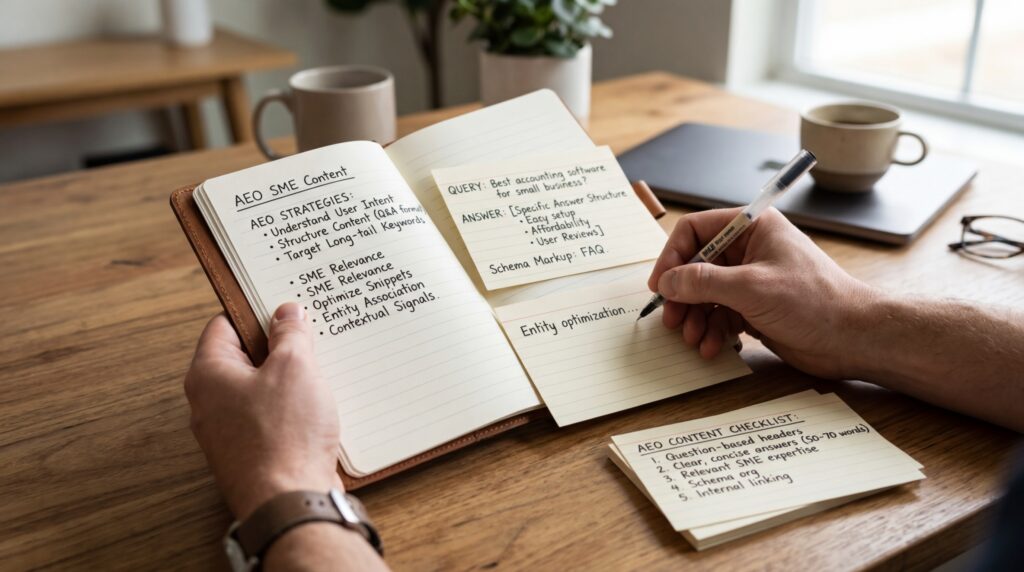
If you run a small or medium business, Answer Engine Optimisation (AEO) for SME Content is no longer something you can put off until next quarter. Small publishers and independent businesses have lost 60% of their traditional referral traffic over the last two years due to the rapid rise of AI-powered answer engines, and in 2026, that shift is accelerating fast.

Key Takeaways
| Question | Answer |
|---|---|
| What is Answer Engine Optimisation (AEO)? | AEO is the practice of structuring your content so AI-powered tools (like ChatGPT, Google AI Overviews, and Perplexity) pull it as a trusted answer to user questions. You can read our full explainer on what AEO is for a deeper overview. |
| Why does AEO matter for SMEs specifically? | SMEs rely on organic visibility to compete with bigger brands. AI answer engines are now the first place many customers go to research a purchase, so your content needs to be ready to be quoted. |
| What content formats work best for AEO? | FAQ sections, structured how-to guides, concise definition paragraphs, and long-form articles with clear subheadings all perform well with AI citation engines. |
| How is AEO different from traditional content marketing? | Traditional content targets human readers browsing a list of links. AEO targets AI systems that read your content and decide whether it’s authoritative enough to quote directly in a generated answer. |
| Do SMEs need a big budget to do AEO? | No. AEO is largely about the quality and structure of your content. Small businesses with focused niche expertise often have a natural advantage over larger, more generic competitors. |
| Where should I start with AEO for SME content? | Start with your most common customer questions. Build a clear FAQ, add structured content to your key service pages, and make sure your website is technically sound. Our free website audit is a great first step. |
| Is there a first-mover advantage in AEO? | Yes, significantly. Early adopters are capturing 3.4x more AI-driven traffic than competitors who have waited. The sooner your content is structured correctly, the sooner AI tools start citing you. |
What Is Answer Engine Optimisation (AEO) for SME Content?
Answer Engine Optimisation (AEO) for SME Content is the process of writing and structuring your website content so that AI-powered tools treat it as a reliable, citable source when a user asks a question.
Think of tools like ChatGPT, Perplexity, and Google’s AI Overviews. When someone types “what’s the best local accountant in Leeds?” or “how do I fix a leaking radiator?”, these tools don’t show a list of links. They generate a direct answer, pulling content from sources they trust.
For SMEs, the goal of AEO is to make sure your business is one of those trusted sources. That means writing content that’s clear, accurate, well-structured, and genuinely helpful, rather than padded out with filler.
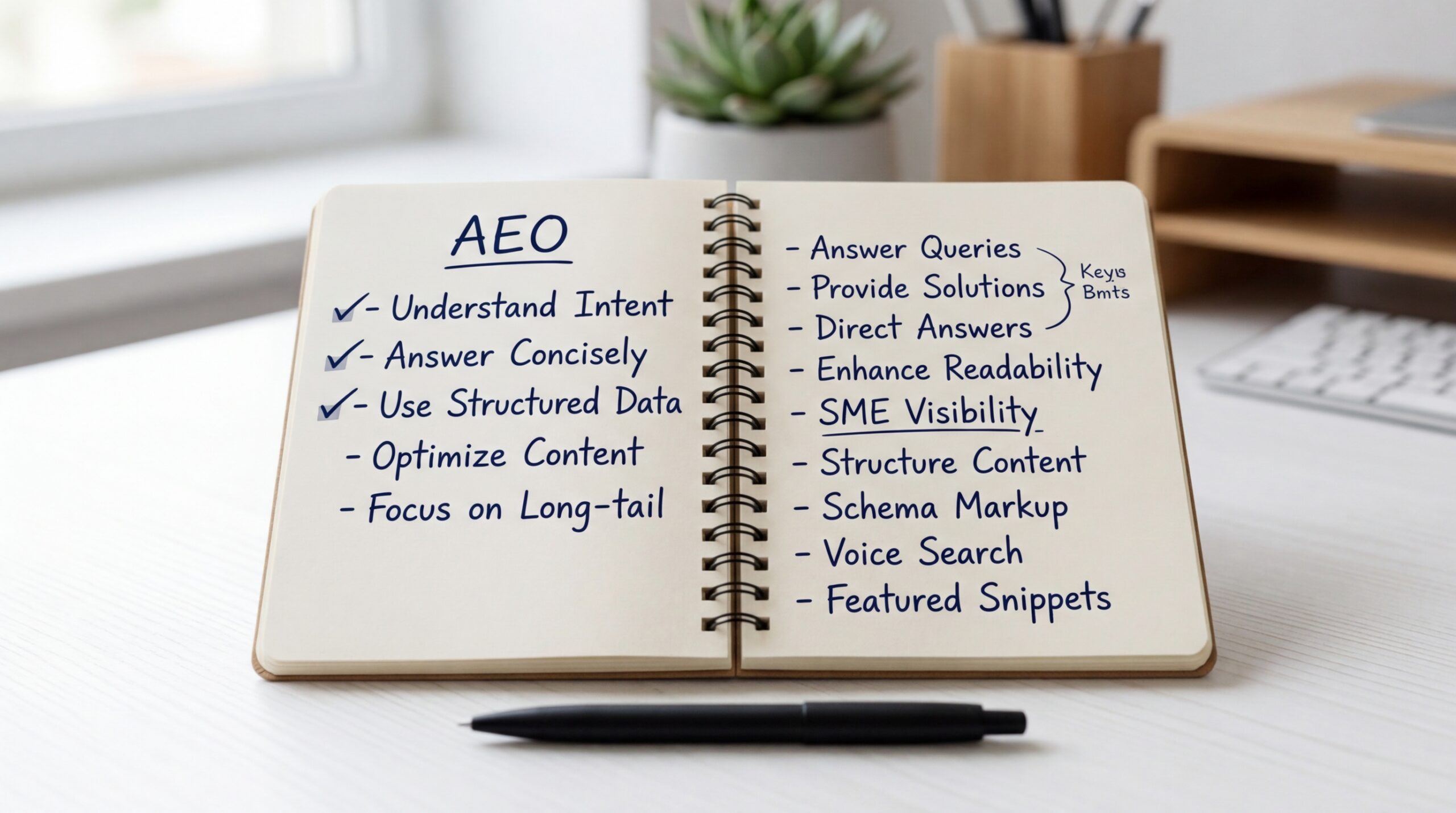
Why AEO for SME Content Is a Survival Strategy in 2026
We know the word “survival” sounds dramatic, but the numbers back it up. Organic click-through rates drop by an average of 61% on queries where an AI Overview is present. That means if an AI tool is answering your potential customer’s question, and your business isn’t part of that answer, you’re largely invisible.
This isn’t a problem that’s coming. It’s already here, and it’s growing.
Large brands have dedicated content teams adapting to this shift. As a small business, your advantage is focus. You know your niche better than anyone, and that depth of expertise is exactly what AI tools are looking for when they decide who to cite.
AEO for SME content isn’t about chasing trends. It’s about making sure the genuine expertise you already have is presented in a way that AI tools can read, understand, and recommend.
Did You Know?
AI search traffic converts at an average rate of 14.2%, compared to just 2.8% for traditional Google organic search.
Source: axfcreative.com
Best for Getting Started: How Answer Engine Optimisation Works for SME Content
If you’re new to this, the good news is that the core principles of Answer Engine Optimisation (AEO) for SME content are straightforward. AI tools prioritise content that is structured, specific, and trustworthy.
Here’s a simple breakdown of what that looks like in practice:
-
Write in clear, direct language. AI tools prefer content that gets to the point. Short, well-defined answers within your longer content are more likely to be cited.
-
Use question-based headings. Structure your subheadings as the questions your customers actually ask. This mirrors how users phrase queries to AI tools.
-
Include a dedicated FAQ section on your key service and product pages.
-
Add structured data (schema markup) to your pages. This gives AI tools a machine-readable layer of context about who you are and what you offer.
-
Write with real expertise. Generic content gets ignored. Specific, experience-backed information gets cited.
-
Keep your content up to date. AI tools favour content that reflects current knowledge. Stale pages from 2019 won’t cut it in 2026.
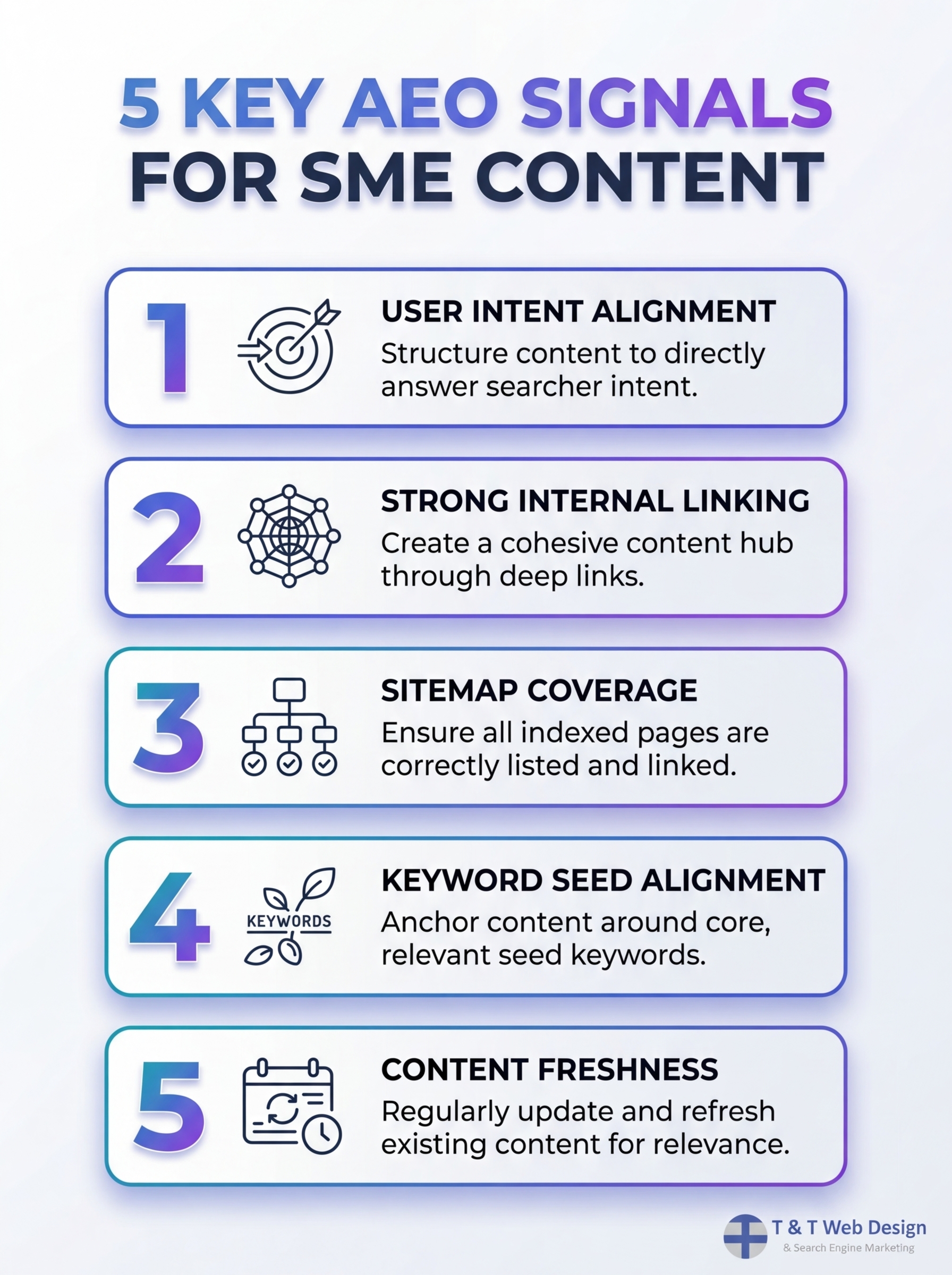
This infographic highlights five essential AEO signals for SME content. Learn how to leverage them to improve visibility in answer engines.

Best for FAQs: Question-Based Content That Answer Engines Quote
FAQ sections are one of the most reliable tools in Answer Engine Optimisation (AEO) for SME content. They work because they mirror the exact format AI tools use to generate responses: a clear question, followed by a concise, accurate answer.
The mistake many SMEs make is writing FAQs for humans only, without thinking about how an AI reads them. Here’s how to write FAQs that serve both:
-
Use the exact language your customers use. If your customers ask “how much does a boiler service cost?”, that’s your heading, word for word.
-
Give a direct answer in the first sentence. Don’t bury the answer three paragraphs in.
-
Keep answers between 40 and 60 words where possible. This is the sweet spot for AI citation snippets.
-
Add FAQPage schema markup. This tells AI tools the content is structured as questions and answers, making it far more likely to be pulled into a generated response.
-
Cover the full customer journey. Include questions about awareness (“what is X?”), consideration (“how does X work?”), and decision (“how much does X cost?”).
It’s a good idea to revisit your FAQ sections every three to four months. Customer questions evolve, and keeping your answers current is a clear signal of trustworthiness to AI tools.
Best for Authority Building: Structured Content That AI Tools Trust
Here’s something that often surprises SME owners: 76% of sources cited in AI Overviews are pulled from sites already recognised as top authorities in their niche. That tells us something important.
AEO isn’t a shortcut to bypass building genuine authority. It’s a way to make sure the authority you already have is presented in a format that AI tools can recognise and use.
For SMEs, authority building in the context of AEO comes down to a few specific things:
-
Depth over breadth. One genuinely comprehensive, well-researched guide on a specific topic you know inside out is worth more than ten thin articles covering the same ground loosely.
-
Author credibility signals. Include clear author bylines, professional bios, and credentials where relevant. AI tools are designed to assess the trustworthiness of content sources.
-
External mentions and backlinks. Being cited by other reputable websites reinforces your authority in the eyes of AI systems.
-
Consistent, accurate information. Contradictions between your website, social media, and directory listings can undermine trust with AI tools.
-
Up-to-date content. Revisit and refresh your most important pages regularly, especially if your industry changes quickly.
For SMEs who want to build this kind of structured authority without a full-time content team, our SEO+ package at £140 per month includes two long-form articles (1,500 to 2,000 words each) per month, built with exactly this approach in mind.

Best for Local Businesses: Answer Engine Optimisation (AEO) for SME Content That Converts
If you serve a specific geographic area, local AEO is one of the most impactful things you can do for your business in 2026. When someone asks an AI tool “who’s the best plumber in Sheffield?” or “find me a dog groomer near me”, the AI pulls from businesses whose content clearly and specifically addresses local intent.
Here’s how local SMEs can make their content more AI-friendly:
-
Name your location explicitly throughout your content. Don’t assume AI tools know where you are. Tell them, repeatedly and naturally.
-
Use LocalBusiness schema markup. This structured data format tells AI tools your business name, address, phone number, opening hours, and services.
-
Create location-specific service pages. If you serve multiple towns, a separate, genuinely useful page for each location performs far better than a single generic page.
-
Keep your Google Business Profile fully updated. AI tools cross-reference this data, and inconsistencies can reduce your chances of being cited.
-
Answer local questions in your content. Write about the specific challenges, regulations, or preferences relevant to your area. This hyper-local specificity is something large national brands struggle to match.
The converting power of AI-driven traffic is real. Visitors who arrive via an AI referral spend 68% more time on-site and view 3.2x more pages than visitors from other sources, meaning the people who find you through an AI tool are genuinely interested in what you offer.
Best AEO Content Formats for SMEs: A Side-by-Side Comparison
Not all content formats are equally useful for Answer Engine Optimisation (AEO) for SME content. The table below gives you a clear picture of which formats work best and for what purpose.
| Content Format | Best For | AEO Value | Difficulty |
|---|---|---|---|
| FAQ Pages | Capturing common customer questions | Very High | Low |
| Long-Form Guides (1500+ words) | Establishing niche authority | Very High | Medium |
| How-To Articles | Step-by-step process queries | High | Low-Medium |
| Definition Pages (“What is X?”) | Top-of-funnel awareness queries | High | Low |
| Comparison Articles (“Best X for Y”) | Decision-stage buyers | High | Medium |
| Case Studies | Demonstrating real-world expertise | Medium-High | Medium |
| Short Blog Posts (under 600 words) | News and updates | Low | Low |
If you’re working with limited time and budget, the biggest return comes from FAQ sections and long-form guides. These two formats alone can make a substantial difference to how often AI tools cite your content.
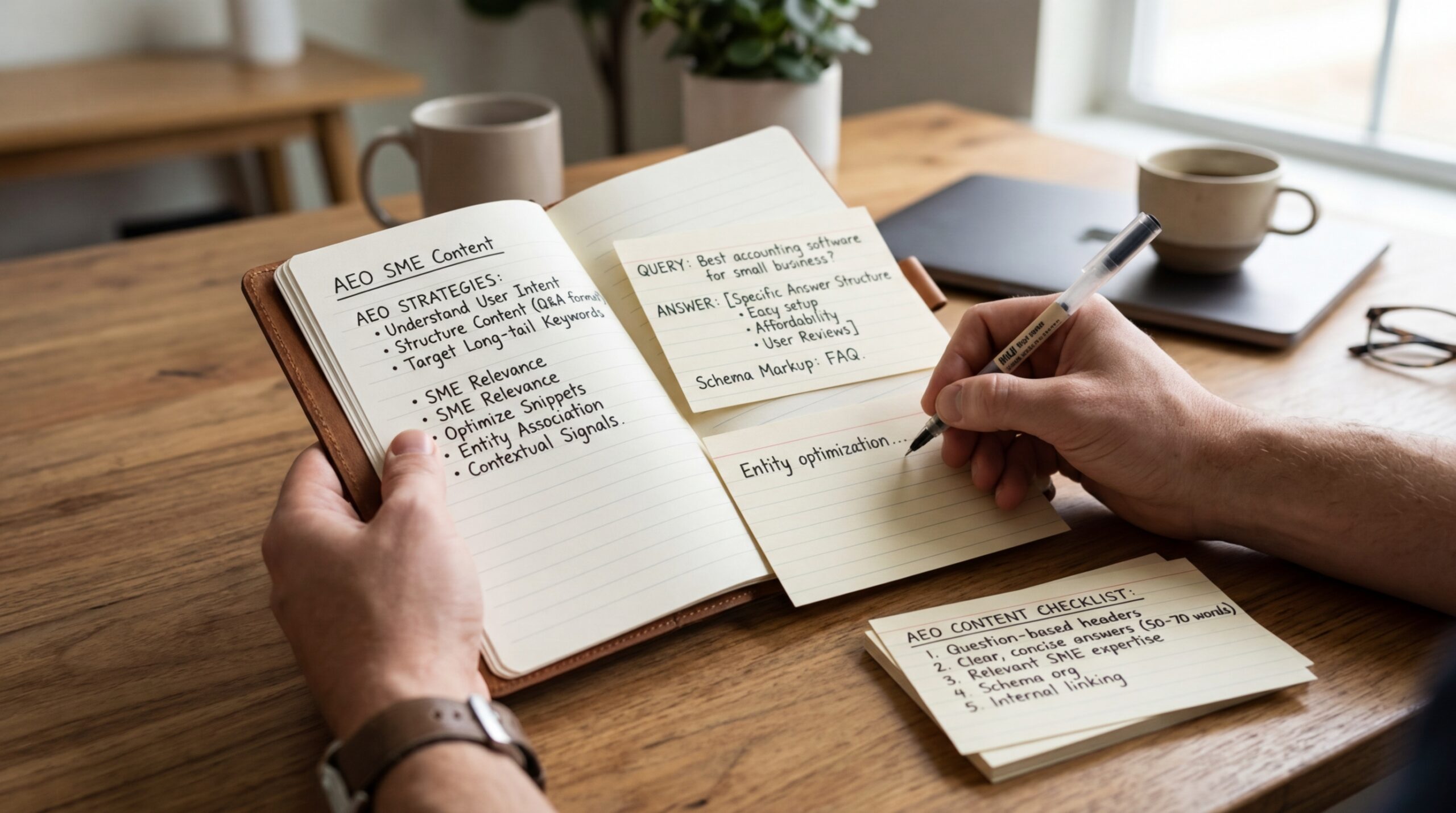
Best for Blog Content: Long-Form Articles That Get Cited by AI
Long-form content is one of the most powerful tools in the Answer Engine Optimisation (AEO) for SME content toolkit. AI tools like comprehensiveness. An article that answers the main question, then addresses related questions, then covers common follow-ups, is exactly what they’re designed to surface.
For SMEs, this means writing articles of at least 1,500 words on topics you genuinely know well. Here’s how to structure them for maximum AEO impact:
-
Open with a direct, clear answer to the main question in the first paragraph. Don’t save the conclusion for the end.
-
Use descriptive H2 and H3 subheadings that are phrased as questions or specific topics. These act as “answer anchors” for AI tools.
-
Include a summary or key takeaways section. AI tools often pull from structured summaries rather than flowing prose.
-
Use bullet points and numbered lists to break down processes and comparisons. These formats are highly “citation-friendly”.
-
Cite sources where relevant. Linking to credible, current external references signals trustworthiness to AI systems.
-
End with clear next steps. A strong, useful conclusion that wraps up the topic neatly is more likely to be quoted in full.
“88% of AI search summaries now cite three or more unique sources. That means being one of several authoritative voices on a topic, rather than trying to ‘win’ the whole conversation, is a realistic goal for any well-run SME.”
At T&T Web Design, our SEO+ package at £140 per month is built around exactly this approach: two long-form, well-structured articles per month, written with your niche expertise at the centre.
Did You Know?
Early adopters of AEO strategies are capturing 3.4x more traffic from answer engines compared to competitors who delayed implementation.
Source: Spearpoint
Answer Engine Optimisation (AEO) for SME Content: Common Mistakes to Avoid
We’ve worked with a lot of small businesses on their content, and certain mistakes come up again and again when it comes to AEO readiness. Here’s what to watch out for:
-
Writing only for humans, not for AI readers too. Your content needs to be clear and well-structured enough that a machine can parse it accurately, not just a person reading it with context.
-
Burying the answer. If your key information is hidden inside a long introduction, AI tools won’t find it easily. Put the answer up front.
-
Ignoring technical structure. No schema markup, poor heading hierarchy, and slow page load speeds all reduce your chances of being cited.
-
Covering too many topics on a single page. Focused, single-topic pages perform far better than pages trying to cover everything at once.
-
Letting content go stale. A page last updated in 2021 is a red flag for AI tools assessing the freshness and reliability of a source.
-
Using jargon without explanation. Write as if you’re explaining something to a smart client who isn’t an expert in your field. AI tools serve general audiences, and clarity always wins.
-
Neglecting your “About” and author pages. AI tools check the credentials of who’s behind the content. A clear, detailed “About Us” page supports your overall trustworthiness.
If you’re unsure how your current content stacks up, our free website audit gives you a clear, jargon-free picture of where you stand and what needs attention.

How We Help SMEs with Answer Engine Optimisation (AEO) Content
We’re Tony and Trudy, and we’ve been helping small businesses get found online for years. We get small businesses because we were one. We understand that you don’t have unlimited budget or a content team of twenty, and we build our services around that reality.
Here’s how we support SMEs specifically with AEO-ready content:
-
Long-form article writing built around your niche expertise, structured for AI citation from the ground up.
-
FAQ development based on the actual questions your customers ask, formatted correctly with schema markup.
-
On-page structure review to make sure your headings, content hierarchy, and technical setup support AEO best practice.
-
Monthly reports so you can see exactly how your content is performing, in plain language without the jargon.
-
Affordable pricing with our standard package starting from £95 per month and our SEO+ content package at £140 per month, so you get proper results without breaking the bank.
We focus on fundamental techniques that work. No magic promises, no overly complicated strategies, just clear and consistent work that builds your authority over time. You can take a look at our full service pricing page to see exactly what’s included at each level.
If you’d like to know what your website looks like right now before committing to anything, our free ranking report will show you where you stand across multiple platforms, including a website quality audit.
Frequently Asked Questions
What is the difference between AEO and SEO?
AEO focuses on getting your content quoted directly in AI-generated answers, while SEO focuses on ranking in search engine results pages. Both matter, but AEO prioritises structured, concise, and authoritative answers that AI tools can easily extract and trust.
How long does it take to see results from AEO?
Most SMEs start seeing early signals within 4–8 weeks, especially if updating existing content. However, consistent results typically take 3–6 months as AI tools reassess your site’s authority, structure, and freshness over time.
Do I need to rewrite all my existing content for AEO?
No. Start by optimising your highest-traffic or most important pages. Add clear answers, improve structure, include FAQs, and update outdated information. Incremental improvements often deliver faster results than a full rewrite.
Which pages should I optimise first for AEO?
Focus on service pages, high-intent blog posts, and pages that already rank on page one of Google. These have the strongest chance of being picked up by AI tools once properly structured.
How important is schema markup for AEO?
Schema markup is very important because it helps AI tools understand your content at a structural level. FAQPage, HowTo, and LocalBusiness schema significantly increase the chances of your content being selected for AI-generated answers.
Can small businesses really compete with large brands in AEO?
Yes. SMEs often have an advantage because of their niche expertise and specific knowledge. AI tools prioritise relevance and clarity over brand size, meaning well-structured, expert content from SMEs can outperform larger competitors.
What types of questions should I include in my FAQ section?
Include real customer questions across the full journey: basic definitions, how things work, pricing, comparisons, and local queries. Use the exact phrasing customers use to maximise your chances of matching AI queries.
How often should I update my content for AEO?
Review key pages every 3–6 months. Update statistics, refine answers, and add new FAQs based on emerging customer questions. Freshness is a strong trust signal for AI tools.
Does AEO help with conversions or just visibility?
AEO helps with both. AI-driven traffic is typically higher intent, meaning users who arrive via AI answers are more likely to convert because they’ve already received relevant, trusted information.
What are the biggest mistakes to avoid with AEO?
The most common mistakes are burying answers, using vague or generic content, ignoring structure, and failing to update pages. Clear, direct, and well-organised content consistently outperforms long, unfocused writing.
Changing fast in 2026
The way customers find businesses is changing faster in 2026 than at any point in the last decade. Answer Engine Optimisation (AEO) for SME Content is the practical, actionable response to that change. It’s about making sure your genuine expertise reaches the people who need it, even when they’re asking an AI tool instead of typing into a search bar.
The good news is that small businesses are well-placed to do this well. Your niche knowledge, your specific local expertise, and your authentic customer understanding are exactly the qualities that AI tools reward.
You don’t need a huge budget. You don’t need to start from scratch. You need clear, well-structured content that answers real questions from real customers, updated regularly and built on a technically sound website.
That’s something we can help with, step by step, at a price that makes sense for a small business. If you’d like to know more about how we approach AEO for SME content, feel free to get in touch and we’ll talk you through it without any tech-speak.

